A Buyer’s Guide to the Best Commercial Dishwashers for Restaurants
A Buyer’s Guide to the Best Commercial Dishwashers for Restaurants
Choosing the right warewasher is one of the most critical equipment decisions a restaurant operator can make. The “best” commercial dishwasher isn’t about a single brand or model; it’s about the machine that perfectly fits your kitchen’s volume, space, workflow, and budget. Get it right, and your back-of-house runs smoothly. Get it wrong, and you’re…
A Buyer’s Guide to the Best Commercial Dishwashers for Restaurants
Choosing the right warewasher is one of the most critical equipment decisions a restaurant operator can make. The “best” commercial dishwasher isn’t about a single brand or model; it’s about the machine that perfectly fits your kitchen’s volume, space, workflow, and budget. Get it right, and your back-of-house runs smoothly. Get it wrong, and you’re facing bottlenecks, high utility bills, and constant service calls. This guide will walk you through the key considerations for finding the best commercial dishwashers for restaurants, moving beyond brand names to focus on what truly matters for performance and profitability.
High-Temp vs. Low-Temp: The First Critical Decision
Before you even look at models, you need to decide between two fundamental types of sanitization: high-temperature and low-temperature. This choice impacts installation, operating costs, and drying time.
High-Temperature Dishwashers
High-temp machines use a built-in or external booster heater to raise the final rinse water temperature to at least 180°F (82°C), the temperature required by NSF to sanitize dishes through heat. This hot water rinse causes dishes to “flash dry” almost instantly when exposed to the cooler air, speeding up your workflow.
- Pros: Faster drying times, no chemical residue on wares, lower ongoing cost for sanitizer chemicals.
- Cons: Higher upfront cost, significant energy consumption, and usually requires a condensate hood for ventilation, which adds to the installation complexity and cost.
Low-Temperature Dishwashers
Low-temp machines wash at around 120-140°F and use chemical sanitizers (typically chlorine-based) in the final rinse cycle to kill bacteria. Because they don’t require a booster heater, their energy draw is much lower.
- Pros: Lower initial purchase price, lower energy costs, no need for an expensive condensate hood.
- Cons: Requires ongoing purchase of sanitizer and rinse-aid chemicals, longer drying times (dishes must air dry), and potential for chemical residue or odor on glassware if not managed properly.
The choice often comes down to upfront capital versus long-term operating costs. High-volume operations typically favor high-temp machines for their speed, while smaller establishments with limited electrical capacity or ventilation might opt for low-temp models.
Matching the Machine Type to Your Kitchen’s Volume
Commercial dishwashers are not one-size-fits-all. They are categorized by their design and capacity, measured in racks per hour (RPH). Estimating your peak-hour dish volume is essential to avoid buying a machine that can’t keep up or one that sits idle.
Undercounter Dishwashers
These are the most compact option, resembling a residential dishwasher but with much faster cycle times (typically 2-3 minutes). They are ideal for small cafes, bars, and wine tasting rooms where they can be tucked under a counter. Their capacity is limited, usually around 20-35 racks per hour.
Door-Type (Pass-Through) Dishwashers
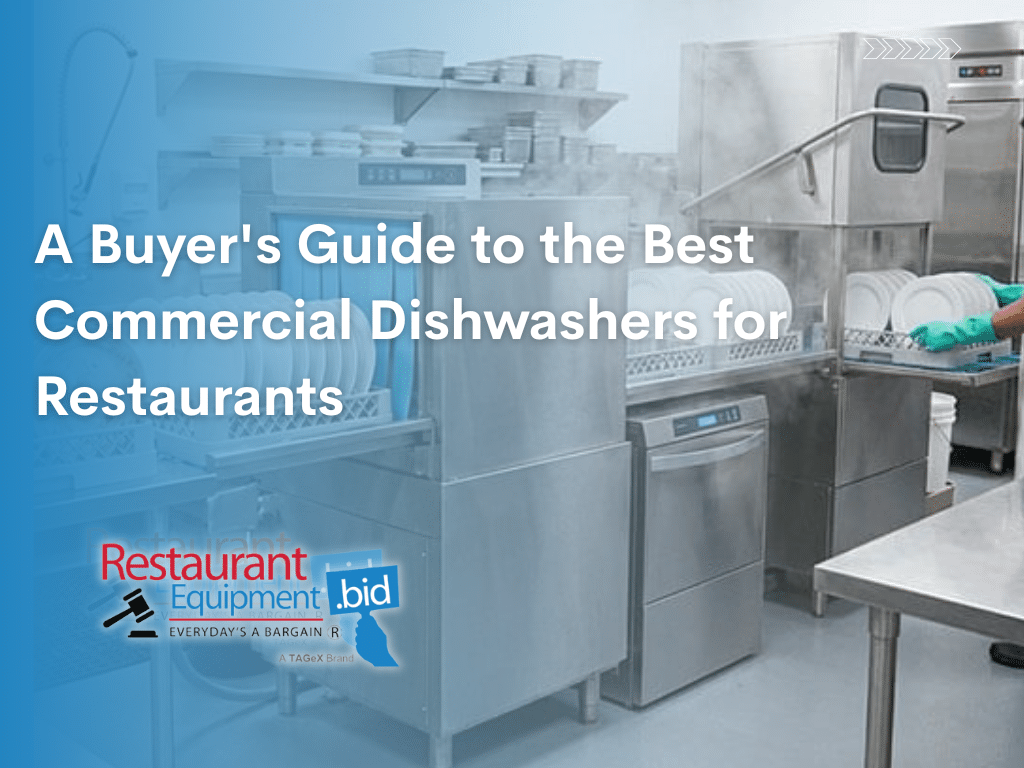
This is the workhorse of most full-service restaurants. A door-type machine sits between two dish tables—one for dirty wares (soiled side) and one for clean wares (clean side). The operator slides a rack in, closes the door to start the cycle, and then opens it to push the clean rack out the other side. They offer a significant capacity jump, typically from 40 to 90 racks per hour, creating an efficient, linear workflow.
Conveyor Dishwashers
For the highest-volume operations like hospitals, large hotels, and university cafeterias, conveyor machines are the standard. Racks are placed on a conveyor belt that automatically pulls them through separate wash, rinse, and sanitizing chambers. These units can process hundreds of racks per hour but come with a large footprint and high utility demands. When searching for restaurant equipment, you’ll find these are a major capital investment.
Key Specifications That Directly Impact Your Bottom Line
Once you’ve narrowed down the type and temperature, focus on these critical specifications that influence your daily operating costs and efficiency.
- Energy Star Certification: An Energy Star-rated machine is independently certified to use less water and energy than standard models. This can save you hundreds or even thousands of dollars in utility costs over the machine’s lifespan.
- Water Consumption: Look for the “gallons per rack” spec. A more efficient machine might use less than 0.7 gallons per rack, while an older or less efficient model could use well over a gallon. This difference adds up quickly.
- Cycle Time: How long does one complete cycle take? Faster cycle times mean higher throughput during your busiest rushes. Most door-type machines run cycles between 60 and 120 seconds.
- Electrical Requirements: This is a non-negotiable installation factor. Does the machine require single-phase or three-phase power? What voltage (208V, 240V, 480V)? Ensure your facility can support the machine’s electrical needs before you buy. Mismatched utilities are a common and costly mistake.
Common Mistakes Operators Make When Buying a Dishwasher
Avoiding these common pitfalls can save you significant headaches and money.
- Ignoring Workflow and Space: Don’t just measure the machine’s footprint. You need adequate space for soiled and clean dish tables, three-compartment sinks for pre-scraping, and room for staff to move safely and efficiently. A door-type machine requires a linear flow, which might not work in every kitchen layout.
- Underestimating Installation Costs: The purchase price is only part of the total cost. You must factor in shipping, professional installation by a qualified plumber and electrician, and potentially a condensate hood for a high-temp model.
- Forgetting Water Quality: Hard water is the enemy of any dishwasher. High mineral content causes limescale buildup on heating elements, spray nozzles, and internal components, reducing efficiency and leading to premature failure. Investing in a water softener is often essential to protect your dishwasher investment.
Finding Value in Used Commercial Dishwashers
A new commercial dishwasher can be a major expense, but high-quality used equipment can provide tremendous value. Since these machines are built for heavy-duty use, a well-maintained unit from a reputable brand like Hobart, Jackson, or Champion can have years of service left in it. Restaurant equipment auctions are an excellent source for finding these machines, often from restaurant closures where the equipment was in perfect working order right up until the last day of service.
When browsing used options, look at detailed photos for signs of heavy limescale, check the condition of gaskets and seals, and read descriptions carefully. On platforms like RestaurantEquipment.Bid, all items are sold “as is, where is,” which rewards buyers who do their homework. The savings can be substantial, allowing you to acquire a higher-end model than your budget might allow for new.
Making the Smartest Choice for Your Operation
The best commercial dishwasher for your restaurant is the one that strikes the perfect balance between capacity, efficiency, space, and total cost of ownership. By thinking through your menu, peak volume, and utility connections first, you can narrow your search to the right category of machine. From there, compare specs like water consumption and cycle times to find a unit that will be a reliable and profitable part of your kitchen for years to come.
Ready to explore your options? Browse the current commercial kitchen equipment auctions to find dishwashers from leading brands. You can find everything from compact undercounter units to high-capacity conveyor systems, all starting at just $1.00.
Related posts